Middle Rio Grande Water Quality Monitoring Network
Objectives:
- Maintain long-term monitoring locations in the Albuquerque Reach
- Install and maintain monitoring instruments in MRG southern sub-reaches (Isleta and San Acacia)
- Describe longitudinal patterns in water quality
- Evaluate the effects of disturbances on in-stream conditions
- Assess long-term variation in water quality at both baseflow and during disturbances
Project Summary:
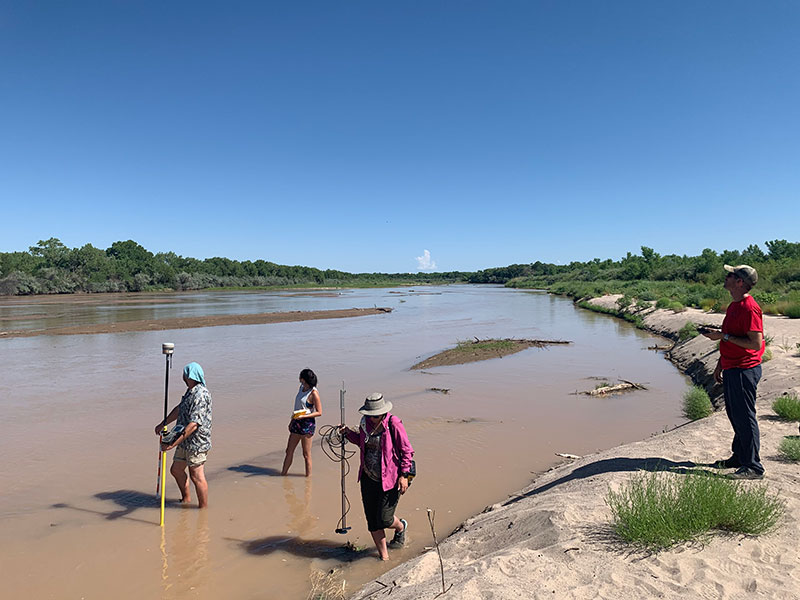
Over the past two decades, significant progress has been made in collecting and analyzing water quality data in the Middle Rio Grande (MRG), the ~300-km section of the river in New Mexico between Cochiti and Elephant Butte reservoirs. Studies have included discrete sampling campaigns, near-continuous water quality sensors, and approaches that combine continuous monitoring with grab sampling. Together, these efforts have improved understanding of spatial and temporal variation in water quality and highlighted the importance of episodic disturbance events as drivers of water quality. Results indicate that baseline water quality and ecosystem processes are highly variable, with discharge, turbidity, geomorphology, and substrate type influencing processes such as gross primary production, respiration, and trophic conditions, while both natural disturbances (e.g., wildfire and post-fire flooding) and anthropogenic inputs (e.g., wastewater treatment and urban runoff) alter water quality across the system.
Key limitations to understanding MRG water quality include the need for multidecadal data collection to assess long-term trends and the lack of data from sites south of Albuquerque, where agricultural water extraction, return flows, tributary inputs from erosive watersheds, and diversion dams likely influence conditions. The goals of this research are to: 1) maintain long-term monitoring locations in the Albuquerque Reach, 2) install and maintain monitoring instruments in MRG southern sub-reaches (Isleta and San Acacia), 3) describe longitudinal patterns in water quality, 4) evaluate the effects of disturbances on in-stream conditions, and 5) assess long-term variation in water quality at both baseflow and during disturbances.
Undergraduate Interns
- Chloe Bouchie (UNM) – Fall 2025
- Tate Elsaesser (UNM) – Spring 2026