About Us
The Intermountain West Transformation Network (TN) is dedicated to fostering resilience in communities and ecosystems across the Western United. Supported by the National Science Foundation’s Sustainable Regional Systems Program under NSF Grant# 2115169, our work aims to improve regional sustainability with convergent research, collaborating with community partners in the design and implementation of projects. The Network represents a partnership between eight Western U.S. universities and their communities, with The University of New Mexico being the lead institution. The TN engages over 80 partner organizations, including Tribal partners, governmental and non-governmental organizations, public utilities, conservation districts, irrigation districts, and municipalities in its work.
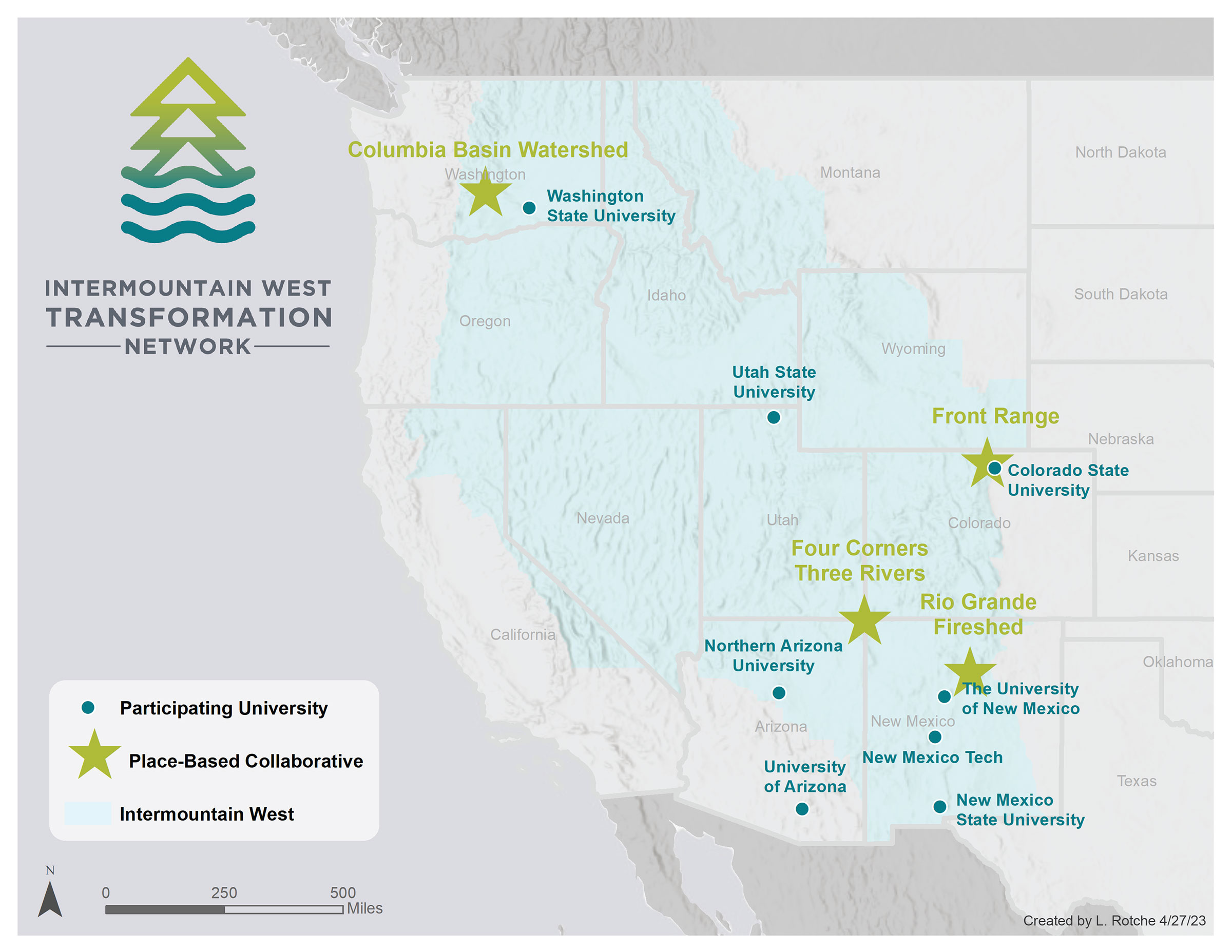
Map created by PhD candidate Lindsey Rotche (UNM)
How We Work
Our Research Approach
The Transformation Network brings together researchers, communities, Tribal Nations, practitioners, and decision-makers to better understand how people and landscapes can navigate rapid social, ecological, and technological change.
Our research integrates insights from social-ecological systems, resilience science, sustainability transitions, and social-ecological-technological systems (SETS) research. We work collaboratively with partners to identify community priorities, understand the dynamics driving change, and explore practical pathways for action. This approach emphasizes co-produced knowledge, multiple ways of knowing, and the importance of translating research into real-world solutions.
The Guided Transformation Framework
A central contribution of the Transformation Network is the Guided Transformation framework, a conceptual framework developed by Network researchers to help communities navigate complex change. The framework recognizes that climate change, drought, wildfire, population growth, and other challenges can create “windows of opportunity” for innovation. Rather than allowing change to unfold by chance, Guided Transformation helps communities identify desirable future pathways and intentionally work toward them.
The framework combines concepts from resilience theory, social-ecological-technological systems (SETS), and sustainability transitions research to support collaborative planning and decision-making. It has been applied in diverse settings across the Intermountain West, including watershed governance, water management, and food-energy-water systems, demonstrating how communities can leverage periods of disruption to build long-term resilience and well-being.
Learn More
Our approach is described in greater detail in a special collection of papers published in a special issue of Ecology & Society:
- Morgan, M., Y. C. Lin, M. Walsh-Dilley, A. J. Webster, A. B. Stone, K. Chief, N. G. Estrada, K. Ayers, H. Love, P. A. Townsend, S. A. Hall, R. R. Rushforth, R. R. Morrison, J. Boll, and M. C. Stone. 2025. Convergence, transdisciplinarity, and team science: an interepistemic approach. Ecology and Society 30(1):3.
https://doi.org/10.5751/ES-15492-300103 - Morgan, M., A. J. Webster, J. C. Padowski, R. R. Morrison, C. G. Flint, K. Simmons-Potter, K. Chief, B. Litson, B. Neztsosie, V. Karanikola, M. Kacira, R. R. Rushforth, J. Boll, and M. B. Stone. 2024. Guided transformations for communities facing social and ecological change. Ecology and Society 29(4):20.
https://doi.org/10.5751/ES-15448-290420 - Morgan, M., A. J. Webster, R. R. Morrison, M. C. Stone, A. B. Stone, J. Boll, and J. Srinivasan. 2026. Convergence research: contributions from sustainable regional systems. Ecology and Society 31(1):3.
https://doi.org/10.5751/ES-16796-310103
