
August 24, 2026
By Philip Moffatt and Jan Boll, Washington State University
The Palouse Region in eastern Washington, north-central Idaho, and north-eastern Oregon includes 8.2 million acres of dryland crop production, supplying 13% of the nation’s total wheat and 80% of the nation’s soft white wheat for export. Annual precipitation increases from the western edge (6 inches) to the eastern edge (25 inches) of the region. Historically, tillage and summer fallow practices (leaving the fields bare) led to some of the world’s highest soil erosion rates in the early 20th century.
In addition to this challenging legacy, Palouse region growers, like many in agriculture, have experienced increasing financial pressures due to steadily rising input costs combined with yearly volatility in wheat commodity prices. In addition, they struggle with the acidification of their soils and concerns about product quality. These pressures led Palouse growers to ask a fundamental question: What if agricultural success were measured not primarily by yield, but by the long-term health of the soil that sustains it?
Regenerative agriculture offers an answer by fundamentally rethinking and redesigning food and related practices in order to (re)build and contribute to soil health, community cohesion, integrated policies, and sustainable diets (see Figure 1). Six regenerative core principles provide a framework adaptable to diverse farming systems and regional conditions: (1) promote context-specific practices, (2) minimize soil disturbance, (3) keep soil covered, (4) maximize biodiversity, (5) maintain living roots, and (6) integrate livestock. You might ask if this is a new form of farming, but essentially it is grounded in Indigenous and early farming across the world.
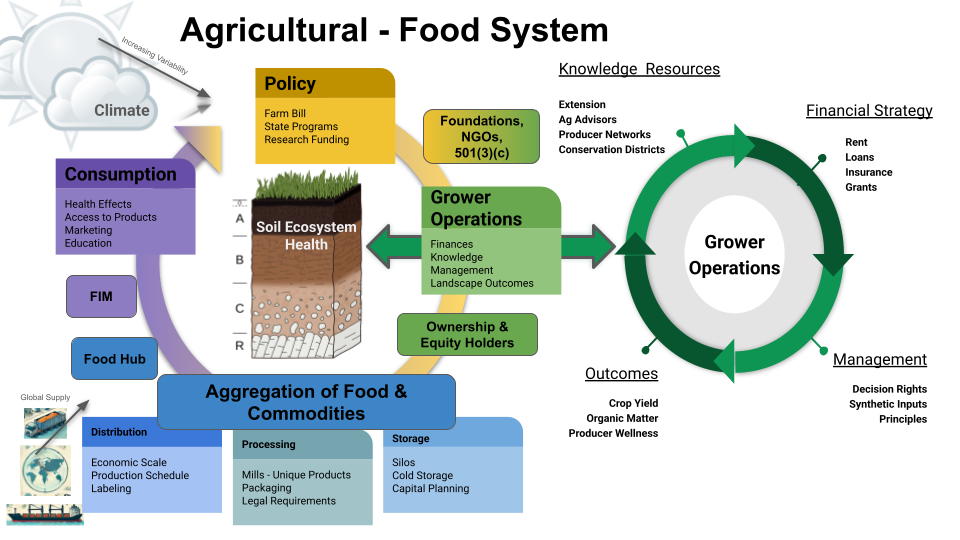
Figure 1: Conceptual model of elements of the food-ag system. In the Palouse case, the model helped growers and partners locate the parts of the system that reinforce current practices as well as the places where coordinated action could open new pathways.
With help from the Spokane and Palouse Conservation Districts, our team connected with two grower networks and collaborations involved in addressing grower concerns and their desire to transition to regenerative agriculture. The Palouse work is part of a broader Transformation Network effort to understand regenerative agriculture across the Intermountain West, strengthened by Richard Rushforth (ASU), Kevin Lombard (NMSU), and Debankur Sanyal (UA) and their engagement with growers in their regions.
Since 2018, these growers have conducted on-farm trials incorporating all six regenerative principles, including using cover crops to suppress weeds, generate cash crops, and provide forage for grazing, as well as alternative seed treatments. Growers in these networks have been at the forefront of changing their operations towards regenerative agriculture, and are interested in this broad shift, which includes a vision beyond their farms.
Working with growers and conservation districts, we realized that regenerative agriculture cannot succeed without many components of the broader system also transforming. Together, we developed a conceptual diagram (Figure 1) that shows that growers are part of a broader system that includes components that impact the soil ecosystem, new food processing and storage features, policies and funding that encourage experimentation and learning, consumer behaviors that understand the health implications of quality food, and more. The diagram became more than a description of the food-ag system: it helped our partners identify systemic barriers and constraints on current infrastructure caused by past decisions and actions (known as lock-ins)—such as commodity-oriented infrastructure and crop insurance incentives—and opportunities for systemic transformation towards regenerative agriculture, such as local processing, ecosystem-service valuation, and stronger buyer-grower relationships.
Through interviews and workshops, Palouse growers described structural, economic, and institutional barriers that lock farms into existing practices and constrain adoption of the six regenerative principles. High costs and operational risks limit experimentation with context-specific practices. The Federal Crop Insurance Program provides important support for commodity crops such as wheat, but can make diversification comparatively risky. Short-term contracts and leases with absentee landowners reduce the security needed for long-term investments in soils. Reliance on herbicides for weed control was particularly entrenched, while alternatives that support the regenerative principles of soil cover and promote biodiversity (such as cover cropping, mechanical, electrification) still lack sufficient local evidence and may require several years to demonstrate benefits. Market structures further deepen lock-in, with wheat-growing being supported by decades of breeding programs, established export supply chains, and a lack of processing infrastructure for alternative crops. Even efforts to grow wheat using regenerative practices that improve soil health and ecosystem services face lock-in challenges, as there are few farms and the economics rely on large scale.
Targeted breeding programs for alternative grains and expanded crop diversification offer windows of opportunity in the Palouse region. Crops such as chickpeas, lentils, and canola can help diversify rotations and support local food and fiber markets. Diverse rotations can improve soil function and long-term financial health, contributing unique benefits: cereal grasses produce carbon-rich biomass and access deep soil nutrients, legumes like clover, vetch, peas, and beans fix atmospheric nitrogen, and brassicas (turnips and radishes) break through compacted soil layers, improving aeration and organic matter distribution. Growers who can incorporate a broader mix of crops are also better positioned to navigate price fluctuations and market downturns.
Working with conservation districts, nonprofit organizations, and land-grant universities, growers, buyers, and other regional actors mapped both the current system (Figure 2A) and a desired future system (Figure 2B) that includes stronger Palouse-based supply chains, ways to value ecosystem services, and pathways for potentially higher-quality foods. By envisioning the desired system, participants can move from general interest in regenerative agriculture to specific next steps: testing crops, building buyer commitments, coordinating technical assistance, and designing certification approaches that maintain management integrity.
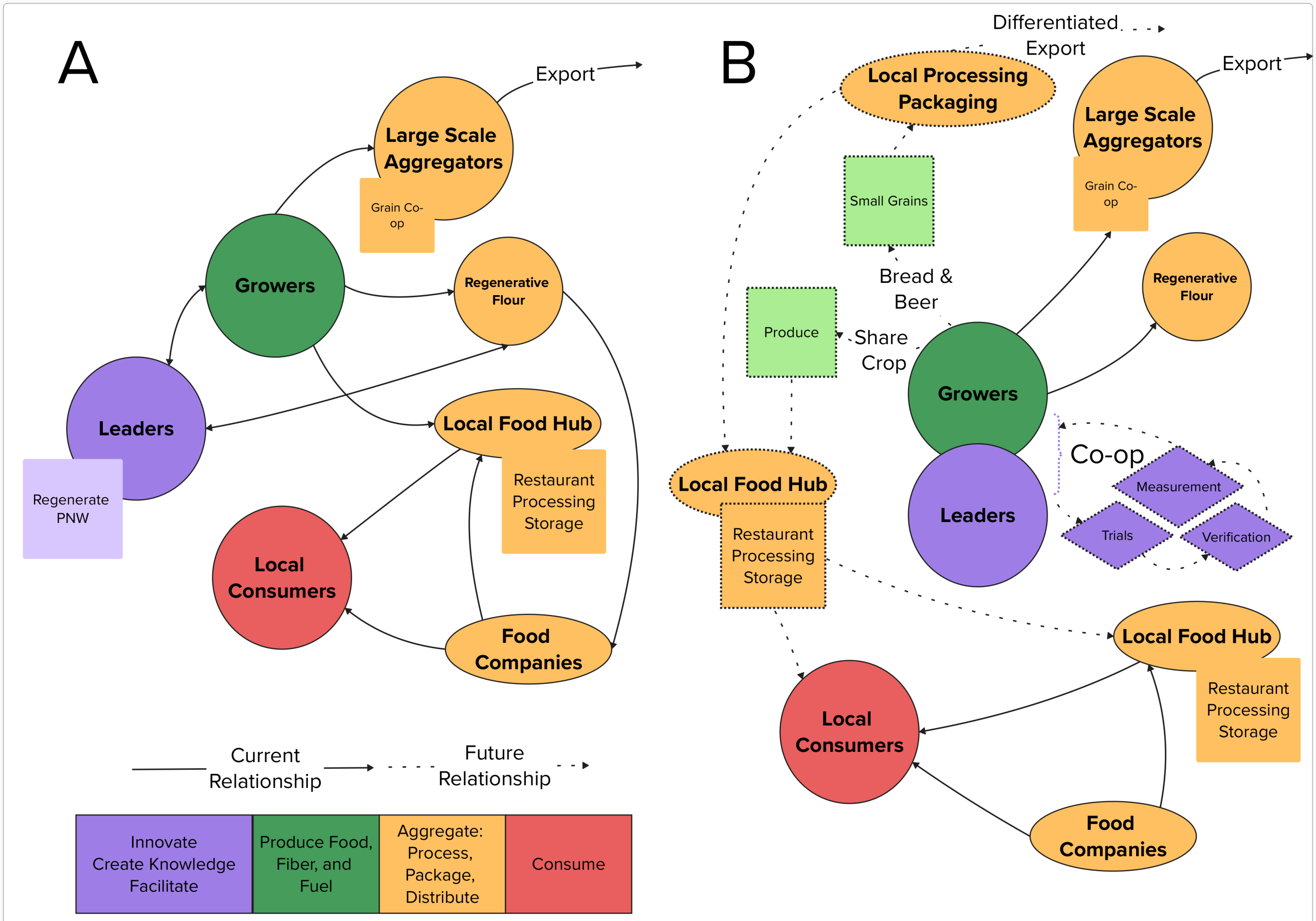
Figure 2: Current (A) and desired future (B) state agriculture-food systems in the Palouse region. Colors represent system actor functions; dashed lines reflect new relationships or actors envisioned at the Palouse region workshop.
Our findings across the Palouse region show that the transformation to regenerative agriculture comprises regional, place-based efforts led by local groups, such as conservation districts, non-profit organizations, and regional land-grant universities. These efforts must contend with an existing agricultural system full of lock-ins and long-standing investments that sustain its current structure. For growers facing economic hardship, waiting for markets, research programs, policies, or government support to adapt on their own may not be feasible. The guided transformation process we worked through together offers a way to move beyond passive waiting by helping regional groups identify the barriers that keep current practices in place and choose leverage points they can act on together. By connecting farm-level experiments with markets, supportive programs, technical partners, and consumer demand, regional groups can increase the odds of transformation and help growers pursue soil health alongside yield.