October 28, 2026
By Sonia A. Hall, Center for Sustaining Agriculture and Natural Resources, Washington State University
Across the Intermountain West, rural and urban communities are faced with a variety of complex challenges related to changing environmental conditions—more frequent and more severe drought, wildfires, and floods—as well as changing social contexts, technology, infrastructure, and more. For example, wildfires impact ecosystems, people, and the water we use to survive and produce food. How we have produced food over decades has in many cases impacted our soils and ecosystems as well as the quality of our food. Where and how we live is reshaping how our communities interact with, influence and are influenced by with ecosystems across the region.
The Transformation Network’s aim is to help build resilient communities and ecosystems throughout the Intermountain Western United States. Efforts to do so are based, first, on the premise that convergent research—research driven by a specific and compelling societal problem and that requires deep integration across disciplines—can contribute to our understanding of the complex human-environmental dynamics that shape the region, and can be a vehicle for the needed transformational change. In addition, the Transformation Network offers Guided Transformation (GT), a framework crafted to help communities manage change and accelerate progress towards more resilient and sustainable futures.
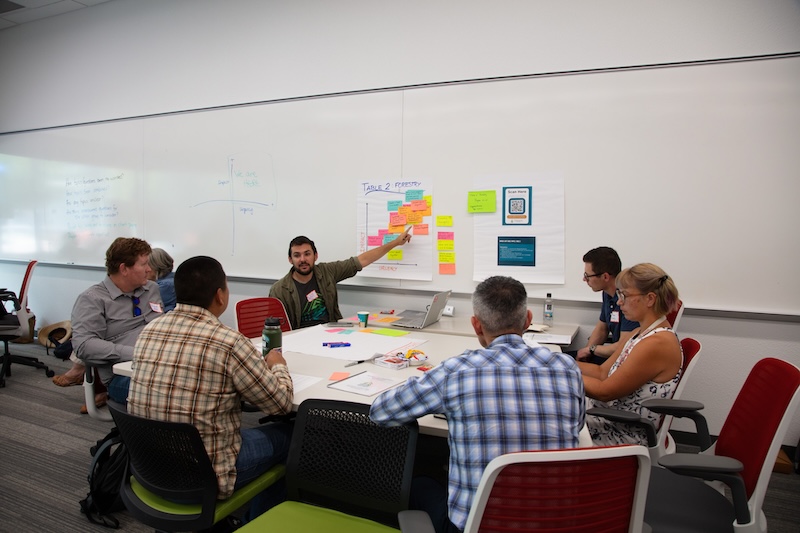
Transformation Network researchers and community partners work together at the Network’s Wildfire and Watershed symposium in October 2024. (Photo by Esther Hewitt)
“G[uided] T[ransformation] [is a framework that] provides a lens for understanding system dynamics and identifying pathways for positive change. The framework’s emphasis on windows of opportunity created by disruptions or crises shifts the focus from merely coping with disturbances to leveraging them for transformation. At the same time, GT recognizes the role of lock-ins and path dependencies in constraining change, while seeking innovations to overcome these barriers.”
How does that work in the real world? How do research efforts contribute to on-the-ground transformational change? Transformation Network researchers provide examples of ways that can occur in the Guided Transformations Series of articles. Through the lens of Guided Transformations, each article describes the system the researchers are working in and the challenge they are tackling, which is associated with an undesirable characteristic or state of that system. They then consider lock-ins or path dependencies that explain how the system got to that state, and how answering their specific research questions can help explore innovations, identify new options or future pathways, or open windows of opportunity for transformational change to happen.
Each article tells a story that connects the dots from research questions to visualizing a path towards a desired future and overcoming the challenges communities face. From productive agricultural systems to wildfire-impacted watersheds that are the source of municipal water, to high-amenity rural places seeing significant change, research contributes to envisioning and acting to craft the pathway to a different future for people and ecosystems.
Read Articles in the Guided Transformations Series:
- Guiding Transformation Towards Community Wellbeing in High Amenity Rural Places by Alexander Theophilus
- More Detailed Modeling of Post-Wildfire Runoff and Erosion Sources Can Help the Management of Forested Municipal Watersheds by Abdisa Kebebew
- Transforming Agricultural Systems in the Palouse Region of the Intermountain West by Philip Moffatt and Jan Boll